Infection Prevention Services (IPS)
IPC Safety Check - Aged Care
IPC Safety Check - Aged Care
Couldn't load pickup availability
Infection prevention failures in aged care rarely come from people not caring. They come from gaps nobody could see: a policy that quietly passed its review date, an antimicrobial stewardship arrangement that exists on paper but not in practice, surveillance data that never quite makes it to the governing body.
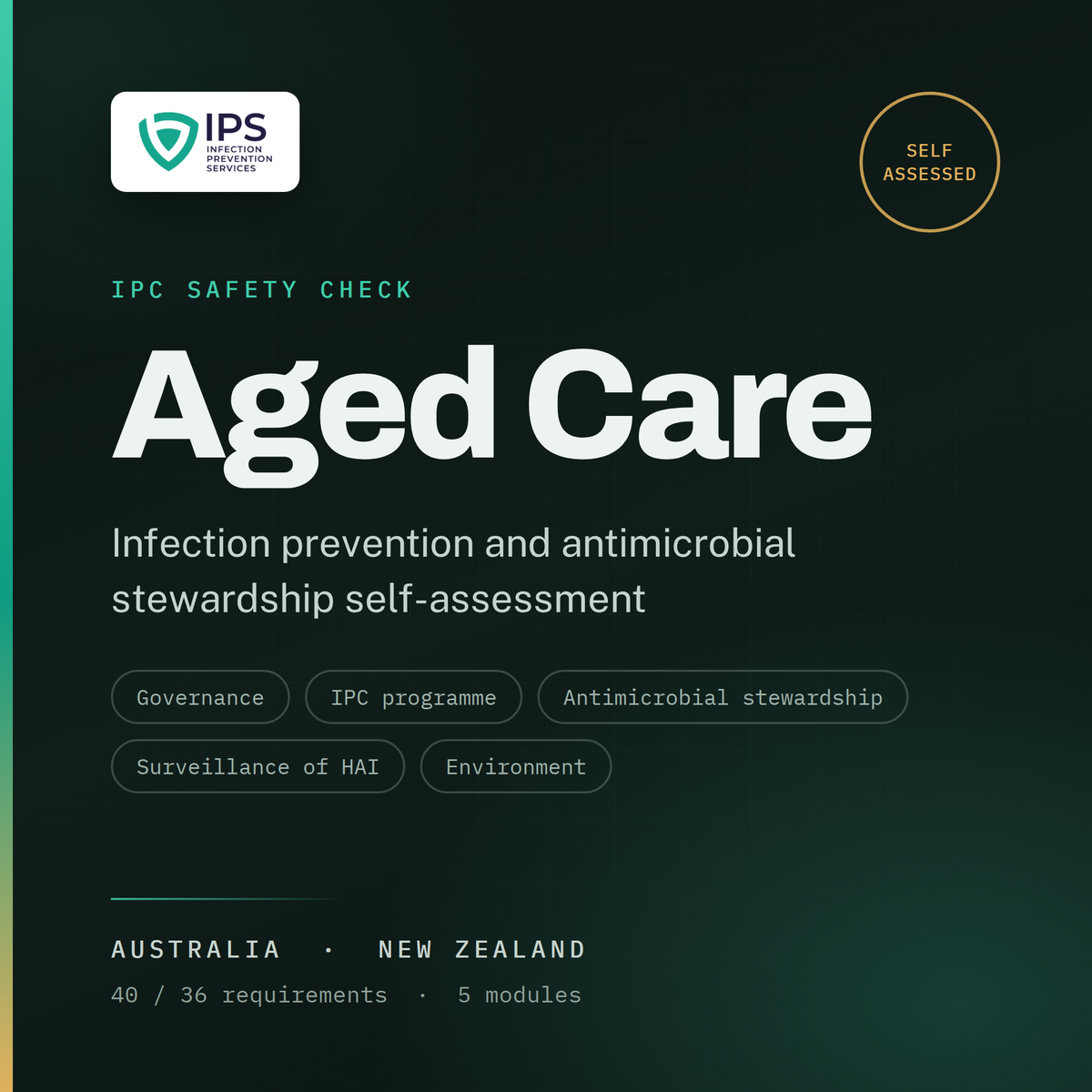
The Aged Care IPC Safety Check is a structured self-assessment that surfaces those gaps while you still have time to close them. You work through it yourself, score your own service honestly, and get back a clear picture of where you stand plus an action plan in priority order.
What it covers
Five modules, built around the way IPC actually works in a residential aged care service:
- Governance — whether IPC and antimicrobial stewardship are genuinely embedded in leadership, accountability and risk systems, or just named in a document
- IPC programme and implementation — the largest module, covering how your programme runs day to day
- Antimicrobial stewardship — prescribing oversight, review processes and the evidence behind them
- Surveillance of HAI — what you collect, how it is analysed, and where it reports to
- Environment — cleaning, laundry, waste and the physical systems that carry risk
Choose your country at checkout
These are two separate assessments, not one tool with the place names swapped.
Australia (40 requirements) is built on the Strengthened Aged Care Quality Standards effective 1 July 2025 and the Aged Care Act 2024, covering Standards 2, 4 and 5. It cross-maps to the ACSQHC Antimicrobial Stewardship Clinical Care Standard, AC-NAPS, Therapeutic Guidelines: Antibiotic, the AMH Aged Care Companion, Hand Hygiene Australia, McGeer and Loeb criteria, AS 5369:2023 and the Cultural Respect Framework.
New Zealand (36 requirements) is built on Ngā Paerewa Health and Disability Services Standard NZS 8134:2021 Section 5. It cross-references Health Quality and Safety Commission guidance, BPAC NZ prescribing guidance, the New Zealand Formulary and Health New Zealand | Te Whatu Ora resources.
How it works
Rate each requirement Met, Partially met, Not met or N/A, and note the evidence you sighted as you go. Most services finish in 30 to 60 minutes. Your answers stay in your own browser, so nothing is sent anywhere and nobody else can see them.
When you are done you get your result, your gaps ranked by priority, and an exportable action plan you can fold straight into your continuous improvement work.
A free consultation is included
Every completed assessment comes with a free consultation with an IPS infection prevention consultant, to help you turn the findings into changes that actually hold.
Please read before you buy
This is a self-assessment for quality improvement. It is not an independent audit, an accreditation outcome, or a certification, and completing it does not verify compliance on your behalf. IPS has not inspected your service. Check the current version of any standard cited before relying on a completed assessment as accreditation evidence.
Share